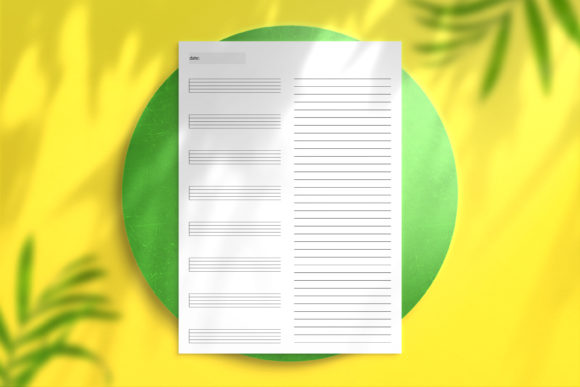
Music Paper with Annotations on Right: A Practical Tool for Composers and Educators
For musicians, composers, and music educators, having the right tools can make a significant difference in workflow and creative output. Music Paper with Annotations on Right offers a structured yet flexible format that supports both composition and teaching. Designed with space for notes, lyrics, or instructions on the right-hand side, this format allows for seamless integration of written context alongside musical notation.
Why Format Matters in Music Creation
Traditional sheet music often separates notation from written explanation, requiring creators to manage multiple documents or scribble notes in margins. With Music Paper with Annotations on Right, users gain a dedicated area for annotations directly adjacent to the staff lines. This layout helps maintain clarity and organization, especially when developing complex arrangements or teaching new pieces.
This format is particularly useful for educators preparing lesson materials or composers working on detailed scores. It eliminates the need to toggle between notation and explanation, making the creative and instructional process more efficient.
Supported Sizes for Diverse Needs
Music Paper with Annotations on Right is available in multiple standard sizes including Letter (8.5×11 inches), Half Letter, A4, and A5. This ensures compatibility with various printing preferences and digital workflows. Whether you're printing physical copies for a class or preparing digital files for remote collaboration, the right size can accommodate your needs.
- Letter size is ideal for full-page compositions and classroom handouts.
- Half Letter offers a compact format suitable for quick sketches or portable use.
- A4 and A5 sizes are well-suited for international users and digital note-taking on tablets or e-readers.
Ready for KDP Upload: A Boon for Self-Publishers
One of the standout features of this product is the 100-page Music Paper with Annotations on Right in Letter size, optimized for Kindle Direct Publishing (KDP) uploads. Self-publishers and educators creating music workbooks can quickly format and upload content without needing additional layout adjustments. This saves time and ensures professional presentation, especially when bundling instructional materials with sheet music.
Whether you're compiling a personal composition journal or publishing a method book, the pre-formatted pages streamline the process. The built-in annotation space also allows for integrated teaching notes, making it easier to produce cohesive, reader-friendly content.
How This Format Enhances Creativity and Communication
Having a designated space for annotations encourages deeper engagement with the music. Composers can jot down harmonic ideas, lyric variations, or performance cues without disrupting the visual flow of the score. Educators can provide contextual guidance directly next to the notation, helping students understand phrasing, dynamics, or historical context.
This dual-purpose layout supports both solo and collaborative work. When sharing drafts with band members or students, the added commentary can clarify intent and reduce misinterpretation. It also simplifies revisions, as notes can be made directly alongside the relevant section of music.
Real-World Applications for Different Users
Musicians and Composers benefit from the ability to keep creative ideas organized in one place. Whether drafting a melody or arranging a full orchestration, having space for notes enhances the development process. The A5 size is particularly useful for on-the-go writing, fitting easily into a bag or case.
Music Educators can create customized lesson plans with integrated explanations. The format supports both traditional instruction and digital teaching environments, especially when using PDF annotations or tablets. The 100-page KDP-ready version is perfect for creating supplementary workbooks or anthologies.
Hobbyists and Songwriters who may not read music fluently can use the annotation space to write lyrics, chord progressions, or rhythmic ideas. This makes the format accessible even to those who primarily compose by ear but want to document their work in a structured way.
When This Format Fits Best
The Music Paper with Annotations on Right format is most effective when context and notation need to be closely linked. It’s less ideal for minimalist sketching or when only a few bars of music are needed. For those who prefer a clean, uncluttered page or who work primarily digitally with notation software, other formats may be more appropriate.
However, for users who value the tactile experience of writing by hand or who frequently print materials for teaching or rehearsal, this format offers a practical balance between structure and flexibility. It's also a strong choice for those who want to avoid the clutter of separate documents or handwritten notes on the back of pages.
Recommendations for Best Use
- Use the annotation space for dynamic markings and articulation notes to guide performers.
- Pair with a digital PDF editor for adding typed annotations or sharing with collaborators.
- Print double-sided when creating notebooks or workbooks to maximize space and reduce paper use.
- Experiment with sizes to find what works best for your writing style and storage preferences.
Final Thoughts
Music Paper with Annotations on Right isn't just a formatting choice—it's a tool that can enhance clarity, streamline workflow, and support better communication in musical contexts. Whether you're composing a new piece, preparing lesson materials, or self-publishing a workbook, the thoughtful layout of this format can help you work more efficiently and creatively.
With multiple size options and a KDP-ready version included, this product offers flexibility for a wide range of users. By integrating notation and commentary in a single space, it helps bridge the gap between musical structure and expressive intent—making it a valuable addition to any musician's toolkit.